B. NEWARK, NJ, 1946
Throughout the last six decades, Nina Yankowitz has created daring and dynamic works of abstraction imbued with her formal and social justice concerns. A founding member of the iconic feminist collective Heresies, Yankowitz since the 1960s has worked across and beyond traditional art forms. Whether taking radical approaches to painting or mounting ambitious multimedia installations, Yankowitz has probed the material, political, and even sonic nature of abstract art.
Born and raised in New Jersey, Nina Yankowitz would skip class in high school to hang around legendary folk music venues in Greenwich Village. By word of mouth, Yankowitz learned of Group 212: a collective of artists, musicians, and poets with whom she spent the summer of 1968 in Woodstock, New York (which became the site of the famed Woodstock Festival). Group 212’s collaborative spirit, and liberal mixing of music and art, inspired Yankowitz to embrace emerging technologies and media. Sound especially came to underpin her practice.
Nina Yankowitz
Canvas Paint Swatches, 1969
Acrylic spray with compressor on canvas and bolts
156h x 72w in
396.24h x 182.88w cm
NYAN014
Yankowitz studied at Temple University and the New School for Social Research before graduating in Fine Art from the School of Visual Arts. Leaving behind painting’s drum-taut support, the Draped Paintings are unstretched canvases that she sprayed with mists of acrylic paint—producing abstract atmospheric expanses and bleeding bands of color. She then hung these works in loose soft folds that cascade vertically down or horizontally across the wall. The artist created her Pleated Paintings in a similar way, yet instead ran lengths of canvas through pleating machines before spraying them with paint. By eschewing the historical precedent of wood stretcher bars, these adaptable paintings assume various forms and identities each time they are installed. The artist installed her Draped and Pleated Paintings in 1967 and 1968 at the renowned Kornblee Gallery, where she later presented important solo shows between 1969 and 1971.
Only a few years after graduating from the School of Visual Arts, Yankowitz was invited to participate in the inaugural 1973 Whitney Biennial. During the mid-1970s, she began attending meetings with a group of feminist artists and writers that would become the Heresies mother collective, producing Heresies: A Feminist Publication on Art and Politics from 1977–93. The group sought to challenge patriarchal art institutions and systems.
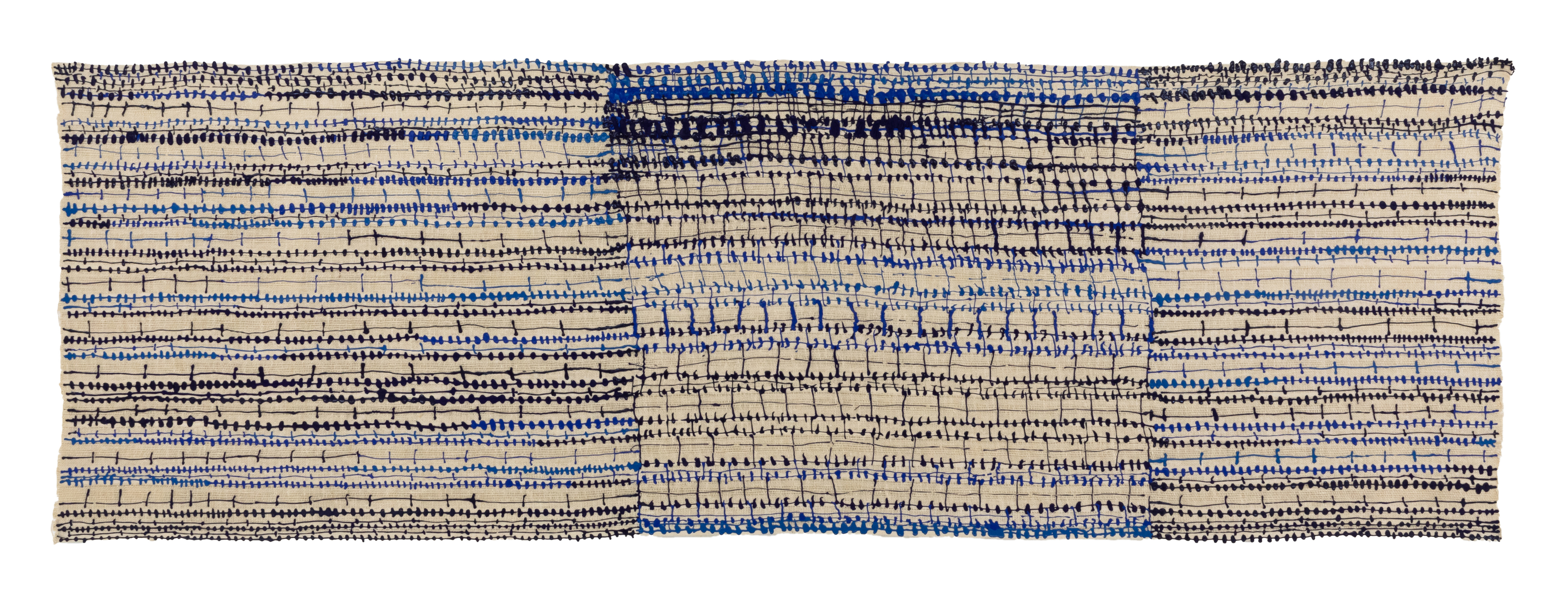
In 1973, Yankowitz moved from her Tribeca studio to a loft building on Spring Street in lower Manhattan, where she began another important series. To create Dilated Grain Readings, the artist squeezed paint from plastic bottles onto unstretched raw linen that she had woven with tight and loose grain patterns for outlining with paint. They seem like color notated musical scores. Indeed, sound informs some of her work. As Yankowitz once explained, “When I hear sound I see color, and when I see color I hear sound.”
During that period, Yankowitz’s works were exhibited and reviewed alongside contemporaries such as the late Sam Gilliam. Like Gilliam, Yankowitz expanded on Abstract Expressionism, pushing the movement to encompass dramatically new forms and modes of presentation. Yet Yankowitz also introduced principles from the Feminist Art Movement into her practice. She incorporated sewing, pleating, and other handicraft techniques maligned as feminine into her painterly process—challenging the notion of “women’s work.”
Yankowitz used non-representation as a vehicle for her sociopolitical concerns. Her embracement of abstraction set her apart from some other feminist artists. As Yankowitz explained: “At the time, I didn't believe you had to reference female issues only by using female-specific imagery to be a feminist artist. But later, looking back to working with Heresies, I recognized the importance of projecting a strong unified voice demanding equal acceptance for a female imagery was necessary to make any change.”
Since the 1970s, Yankowitz has been a staple of the booming postwar art scene on the East End of Long Island. During the ‘70s, Yankowitz spent long periods of time in Southampton at the summer rentals of friends such as artist Hermine Freed and architect James Ingo Freed, and artist Marjorie Strider. The sonic environment there influenced facets of her practice. Yankowitz recalls being struck by the melodies produced by birds and insects, in response to which she created a series of painted scores and audio recordings that evoke the symphonic-like sounds of various voices. Eventually she purchased a house in Sag Harbor in 1993. The artist now lives and works in both Sag Harbor and New York City.
Yankowitz’s works are found in public collections including the Franklin Furnace Collection at The Museum of Modern Art, New York, NY; Guild Hall, East Hampton, NY; Fine Arts Museum of San Francisco, San Francisco, CA; Virginia Museum of History & Culture, Richmond, VA; and the Smith College Museum of Art, Northampton, MA. Her archival materials are found in the Archives of American Art, Smithsonian Institution, Washington, D.C..
Yankowitz has been featured in exhibitions or presented installations at institutions such as The Aldrich Contemporary Art Museum, Ridgefield, CT (1970); Emily Lowe Gallery, Hofstra University, Hempstead, NY (1970); Art Institute of Chicago, Chicago, IL (1972); Kunsthaus, Hamburg, Germany (1972); Storm King Art Center, New Windsor, NY (1973); Bronx Museum of Art, New York, NY (1978); MoMA PS1, New York, NY (1982); 51st Street Lexington Avenue Subway, commissioned by the Metropolitan Transportation Authority, New York, NY (1987); Katonah Museum of Art, Katonah, NY (1990); The Bass Museum of Art, Miami, FL (1996); Art in General, New York, NY (1998); Parrish Art Museum, Water Mill, NY (1998); Guild Hall, East Hampton, NY (2005; 2014); Museum of Modern Art of Ukraine, Kyiv, Ukraine (2011); The Museum of Modern Art, New York, NY (2013); and the Smith College Museum of Art, Northampton, MA (2016), among many others. Most recently she was the subject of a major retrospective at the Museum of Fine Arts, St. Petersburg in 2025.
Nina Yankowitz
Scanning Punctuations, 1975
acrylic paint on canvas
48 x 121 in.
121.9 x 307.3 cm.
(NYAN062)
Nina Yankowitz
Dilated Grain Reading/Blue Pitches, 1974
extruded acrylic/Flashe paint on linen
49 x 148 in.
124.46 x 375.92 cm.
(NYAN001)
Nina Yankowitz
Crunched, 1968
acrylic spray with compressor on canvas
38h x 60w in
96.52h x 152.40w cm
(dimensions variable)
NYAN020
Nina Yankowitz
Opened Flat, 1971
six webbing straps, acrylic spray with compressor, and stitching on canvas
115h x 88w in
292.10h x 223.52w cm
(dimensions variable)
NYAN005
Nina Yankowitz
Puckered Painting, 1970–71
acrylic spray with compressor and stitching on canvas
86h x 62w in
218.44h x 157.48w cm
(dimensions variable)
NYAN003
Nina Yankowitz
Diagonal Draped, 1968
acrylic spray with compressor on canvas
79h x 69w in
200.66h x 175.26w cm
NYAN017
Nina Yankowitz
Shape Break Edge, 1968
Acrylic compressor spray on canvas
145h x 72w in
368.30h x 182.88w cm
NYAN037
Nina Yankowitz
Goldie Lox, 1968
acrylic spray with compressor on canvas
62h x 76w in
157.48h x 193.04w cm
(dimensions variable)
NYAN038
Nina Yankowitz
Abstract Stretch, 1968
acrylic spray with compressor on canvas
NYAN018
Nina Yankowitz
Breaking Bars, 1969
acrylic spray with compressor on canvas
108h x 51w in
274.32h x 129.54w cm
(dimensions variable)
NYAN021
Nina Yankowitz
Draped Xtract, 1970
acrylic spray with compressor on canvas
66h x 64w in
167.64h x 162.56w cm
(dimensions variable)
NYAN023
Nina Yankowitz
Ms. Majesty, 1970–71
acrylic spray with compressor on canvas run through pleating machine
45h x 121 1/2w in
114.30h x 308.61w cm
(dimensions variable)
NYAN028
Nina Yankowitz
Pleated Painting, 1971–72
acrylic spray with compressor on canvas run through pleating machine
90h x 40w in
228.60h x 101.60w cm
NYAN031
Nina Yankowitz
Canvas Paint Swatches, 1969
acrylic spray with compressor on canvas and bolts
156h x 72w in
396.24h x 182.88w cm
NYAN014
Nina Yankowitz
Dilated Grain Reading: Scanning Reds and Blues, 1973
extruded acrylic/flashe paint on linen
50h x 109w in
127h x 276.86w cm
NYAN002
Nina Yankowitz
Dilated Grain Reading/Ochre, Brown, Reds, 1973
extruded acrylic/Flashe paint on linen
48 1/2h x 98w in
123.19h x 248.92w cm
NYAN015
Throughout a career spanning six decades, Nina Yankowitz (American, b. 1946) has continuously pushed against traditional boundaries, forging a practice that defies singular definition. From loosening canvas from the stretcher and allowing it to drape and fold, to creating immersive multimedia environments that spotlight underrecognized histories, Yankowitz has harnessed an experimental approach to material and discipline to engage themes of feminism, environmentalism, and social justice. Nina Yankowitz: In the Out/Out the In, the artist’s first retrospective, presents the full breadth of her wide-ranging and innovative work and brings long-overdue recognition to her significant contributions to the art world.
Spanning six decades of work, Nina Yankowitz opened “In the Out/Out the In,” her first retrospective, at the Parrish Art Museum in Water Mill on October 11. The artist, who continues to push the boundaries between painting, sculpture, video, installation and new media, is known for her interdisciplinary practice approach to creating work.
One question kept surfacing: where is the art itself in relation to her objects? In the work of Nina Yankowitz, this varies hugely. Is it in the physical fabric of her objects? In the images that emerge from woven or painted surfaces? Or does it dwell somewhere more elusive and further afield, in the mental space where I, as a viewer, complete her open-ended sentences? Moving through Yankowitz’s career retrospective, In the Out/Out the In, at the Museum of Fine Arts St. Petersburg this question would not settle.
In the Out/Out the In, on view at the Museum of Fine Arts St. Petersburg, is a career retrospective spanning six decades of work by Nina Yankowitz. She is often characterized as a multi-media artist: Yankowitz is a painter, she is a ceramicist, she is a sculptor; she works in fiber, in video, in installation; she composes soundscapes and operas. She has not just worked in a variety of media, she has innovated in each and brought media together in unexpected and forward-thinking ways.
Throughout a career spanning six decades, Nina Yankowitz (American, b. 1946) has created a multidisciplinary practice that defies singular definition. Her work pushes against traditional boundaries: her paintings have resisted not just frames, but seemingly gravity; her abstract compositions have gone beyond the canvas to embrace the aural. Most recently, Yankowitz has deepened her interest in technology and new media to create immersive environments that spotlight women-centered histories that have gone unknown for far too long.
Nina Yankowitz | In the Out/Out the In will be on view at the Museum of Fine Arts, St. Petersburg from June 21 through September 21, 2025. The exhibition will then travel to The Parrish Art Museum, Water Mill, NY, where it will be on view from October 5, 2025 – February 22, 2026.
Nina Yankowitz takes over an entire gallery to literally offer alternate perspectives for experiencing art: Reclining lounge chairs invite viewers to look up at works by Tara Donovan, Rashid Johnson, Louisa Chase, Mary Heilmann, and Vija Celmins; a 7-foot platform allows a view from above of a visual sound score woven into a rug. Seated in a heavy chair with tiles, viewers confront Chuck Close‘s self-portrait, while small works hang at tilted angles in the distance. Yankowitz chose works relevant to life in America today, including Jackie Black’s Last Meal (Series), 2001–2003, 24 photographs of meals requested by death-row inmates, paired with Yankowitz’ uncanny sculptural paintings of body parts protruding from the wall to imagine “what’s on the other side.”
Described by Monica Ramirez-Montagut as a "homecoming" for artists who have worked with the Parrish Art Museum over the years, the museum's 125th anniversary celebration has officially begun, with the first iteration of its "Artists Choose Parrish" series of exhibitions now on its walls.
In 1972, the year that art historian Cindy Nemser cofounded the Feminist Art Journal, she fired off a letter to the New York Times, taking critic James Mellow to task for labeling a female artist’s exhibition a “one-man show.” “Evidently,” she wrote, “Mellow still has not caught on to the fact that women are not ashamed of their sex and resent being mistaken for men.” After protesting the reviewer’s chauvinistic language—the work was “seductive,” “feminine,” even “en déshabillé”—Nemser closed with a scorcher: “Sexist critics take note. When you start seeing scantily clad females in every abstract painting, they may start calling you ‘a dirty old man.’”
The artist in question was Nina Yankowitz, and the show was her second solo at Kornblee Gallery in New York. This past autumn, some of the same paintings were back on public view in “Can Women Have One-Man Shows?” at Eric Firestone’s two-floor space on Great Jones Street. By alluding to Nemser’s letter so directly, the exhibition not only positioned Yankowitz as a significant figure in feminist art, but also raised the issue of her early work’s reception—or lack thereof.
Toward the end of the 1960s and into the early ’70s, Nina Yankowitz was engaged with core questions about the nature of painting. Then an undergraduate student at New York’s School of Visual Arts—at a time when two- and three-dimensional objects inhabited distinctly separate realms—she voiced a seditious desire to upend the binary: “I want to do both,” she told the head of SVA, according to her 2018 oral history interview for the Archives of American Art. In 1969, at age twenty-three, she had her first full-scale solo show at Manhattan’s Kornblee Gallery (during a period when gallery representation for women was exceedingly rare), where she showed her series of “Draped Paintings,” 1967–72, ten of which were on view in her exhibition here. Freed from the stretcher and large in scale (two of them are more than ten feet high), the reconfigured works were imposing but not overpowering. Using sailboat canvas as her ground, she engaged both surface and space with a playful spirit of experimentation. She applied spray paint with varying degrees of saturation to make colorful abstractions; she then attached the works to the wall with staples, arranging them to accentuate their voluminous folds. In their most elegant iterations, such as the sunrise-hued Goldie Lox, 1968, which modulates from a sparingly pigmented left edge to a warmly saturated right, they married subtleties of color and form. Two pieces from Yankowitz’s series of “Pleated Paintings,” 1970–72, also on view here, showed yet another way in which she pushed her experiments with three-dimensional form, adopting highly textured commercial pleating as an additional compositional tool. Pleated Diptych, 1972, revealed the complex compositions made possible by the combination of the folded substrate and spray, although its overall impact seemed more constrained than in the draped paintings.