


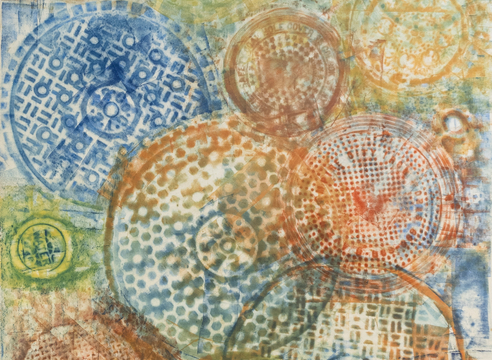
Sari Dienes

Sari Dienes
Spring, 1970
ink on unprimed canvas
112 x 163 1/4 in.
284.5 x 414.7 cm.
(SADI055)
Sari Dienes
Wall I, 1954
mixed media on muslin canvas
93 1/2 x 67 in.
237.5 x 170.2 cm.
(SADI057)
Sari Dienes
CT&ESCO, 1953
mixed media on paper mounted on canvas
35 x 35 in.
88.9 x 88.9 cm.
(SADI185)
Sari Dienes
The Nest, 1950
ink, charcoal, chalk and gouache on canvas
39 x 106 1/2 in.
99.1 x 270.5 cm.
(SADI111)
Eric Firestone Gallery is pleased to announce the exhibition Sari Dienes: Night Eyes, on view February 4 – March 21, 2026 at 40 Great Jones Street, NYC. The show is a survey of the groundbreaking experimental artist, born in Hungary in 1898, whose career links European Surrealism, American Neo-Dada, and Pop art.
Sari Dienes (pron. SHAR-ee deens) is best known for her mixed media frottage paintings (painterly rubbings from textured surfaces) of rural and urban environments. Dienes’s foremost artistic belief was that raw materials and forms exist everywhere, and her goal was to see and reflect them. This attitude influenced her younger contemporaries and friends, including Robert Rauschenberg and Jasper Johns.
Night Eyes is the gallery’s first solo exhibition of Dienes’s work since announcing representation in September 2025. It will include work made between 1935–70: early Surrealist paintings; mixed-media rubbings of New York City manhole covers, walls of Kyoto, and ancient petroglyphs; plaster collages; and assemblage sculptures.
Her paintings, which were shown at four exhibitions at Betty Parsons Gallery in the 1950s, were made by applying pigment to her surfaces with a combination of brushes, rollers, rags, and her fingers. They incorporate a spectrum of colors and touches across their often vast surfaces, resulting in complex abstractions full of movement. They record not just the artist’s painterly marks, but a rich history of human presence beyond her own.
Dienes attended the Académie Moderne, Paris, where she studied with Fernand Léger and Amédée Ozenfant, and later, the Académie Ozenfant. During this time, Dienes frequented the Café du Dôme in Montparnasse, a gathering place for avant-garde artists including Marcel Duchamp, and Man Ray. In 1936, Dienes became assistant director of Ozenfant Academy of Fine Arts in London, recruiting the school’s first students, who included Leonora Carrington and photographer Stella Snead. That same year, she met Max Ernst, a pioneer of Dada and surrealism, whom she would go on to introduce to Carrington.
Dienes came to New York in 1939. Intended as a short trip, she was unable to return to the UK as a Hungarian after the outbreak of the Second World War. Instead, she helped establish the Ozenfant School of Fine Arts in New York. In the mid-1940s, she moved to a large studio at 57th Street, which became a hub for her community. She developed friendships with John Cage, Merce Cunningham and Ray Johnson. All four were studying Zen Buddhism, through a series of lectures given by D.T. Suzuki at Columbia University.
The principles of Zen Buddhism were formative in the development of Dienes’s work. She held the idea that art was about expressing the whole of reality, and embraced the philosophy that artmaking was more about finding than seeking. A three-month trip to Arizona, Colorado, Utah, and New Mexico was also a profound influence.
From 1947–1953, she worked with Stanley William Hayter at the famed Atelier 17 at the New School in New York, NY. Printmaking techniques were an integral part of her practice, even when making unique works. Inspired by Hayter’s use of plaster prints, Dienes began creating plaster collages: shaped wall works marked with surface impressions and embedded with elements like sand, copper, and rope.
During a residency at the Yaddo retreat in Saratoga Springs, NY in 1953, Dienes first made rubbings of natural materials and household objects, using a printer’s brayer and colored inks. After the residency, Dienes brought her materials to the streets of New York. She worked in the wee hours of the night, when the streets were quiet from traffic, taking rubbings of manhole covers and sidewalks. She engaged her friends Cage, Rauschenberg, Johns, Cy Twombly, and Rachel Rosenthal to assist her by making sure the massive sheets and fabrics did not blow away.
Her sculptural assemblage work with glass began in 1956, when she created a series titled “Bottle Gardens,” using found glass bottles. She followed this with mirror constructions she called “brokages,” one of which was included in the 1960 exhibition New Media, New Forms II at the Martha Jackson Gallery, New York. Dienes understood the shattered mirror as a representation of her aesthetic philosophy.
The same year, she was commissioned by the University of Washington to participate in an expedition making rubbings of several hundred Native American petroglyphs soon to be submerged due to the construction of the Dalles Dam across the Columbia River in Washington State. In the late 1950s, Dienes traveled to Japan to further her study of Zen, stopping en route in Hawaii to create more petroglyph rubbings.
In 1961, Dienes moved to Gate Hill, an artistic community known informally as “The Land,” in Stony Point, New York, where she lived amid neighbors including Cage, M.C. Richards, David Tudor, and Johanna and Stan VanDerBeek until her death in 1992. Her relationships with Fluxus artists would deepen during this time. In 1973, she joined the feminist artist cooperative A.I.R., where she exhibited through the end of her life. That same year, she created a home base in New York City in an apartment above the city’s oldest bar. In 1977, along with Rip Hayman and Paco Underhill, she took over the building’s lease, and established it as the Ear Inn. It became the site of experimental art performances.
Dienes was the subject of a 2023 solo exhibition at the Boca Raton Museum of Art, FL; was featured in Women’s Work at the Museum of Modern Art, New York, NY; Fragments of Memory at the Menil Drawing Institute, Houston, TX; Fresh Window: Art of Display and Display of Art at Museum Tinguely, Basel, Switzerland; and On the Street at Kunstmuseum Liechtenstein, all between 2024 and 2025. Dienes’s work is found in the permanent collections of MoMA, New York, NY; the Menil Drawing Institute, Houston, TX; Buffalo AKG, NY; the Brooklyn Museum, NY; the Minneapolis Institute of Arts, MN; Smithsonian American Art Museum, Washington, D.C.; Virginia Museum of Fine Art, Richmond, VA; and the Whitney Museum of American Art, New York, NY, among others.